

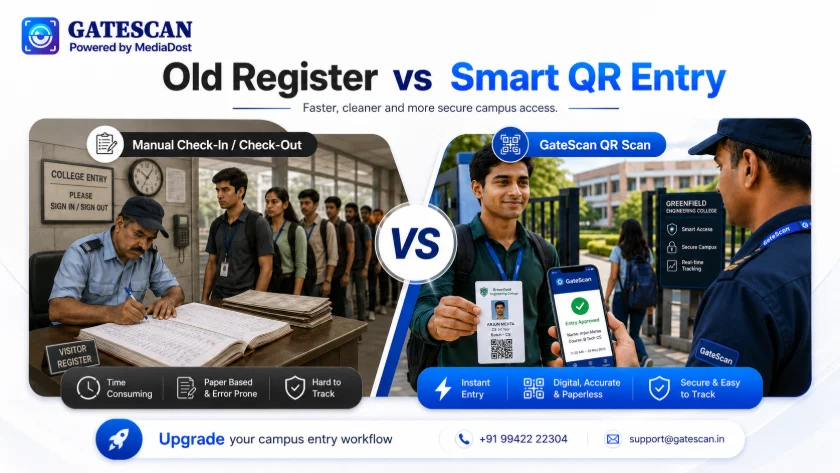
Walk up to almost any college, coaching institute, or hostel gate in Bihar during morning rush hour and you'll likely see the same scene: a guard hunched over a thick, dog-eared visitor register, a queue of students backing up behind him, each one writing their name, roll number, and time by hand before they're allowed in. It's a routine so familiar that most institutes don't even think of it as a problem — until an exam day queue stretches past the gate, a register goes missing before an audit, or a parent asks "how do you actually know my child is safe on campus?"
Bihar's higher education and coaching ecosystem — from engineering and medical colleges in Patna, Gaya, Muzaffarpur, and Bhagalpur to the massive coaching hubs that draw students from every district — has grown faster than most of its campus infrastructure. Gate management is one of the clearest places where that gap shows. GateScan, powered by Media Dost, replaces the register with a QR-based smart entry system built for exactly this kind of scale: instant scans, digital records, and real-time visibility for administrators, wardens, and security staff.

The Hidden Cost of Manual Registers on Bihar's Campuses
A register book looks harmless until you add up what it actually costs an institute:
Time lost at the gate — each manual entry takes 20-30 seconds. Multiply that by a few hundred students during peak morning hours or exam days, and queues back up onto the road.
Illegible, error-prone records — handwritten entries are hard to read, easy to fake, and nearly impossible to search when someone needs to check who entered on a specific date.
No real-time visibility — a warden or security head has no way to see, in the moment, how many people are on campus or who's still inside a hostel after curfew.
Single point of failure — one damaged, misplaced, or water-stained register and months of entry data are gone for good.
Audit and accreditation friction — NAAC, NBA, and UGC inspections increasingly expect digital, exportable records. A stack of handwritten registers is not that.
Weak identity verification — a name written on paper doesn't confirm the person writing it is who they claim to be. Proxy entries and buddy check-ins are common and go undetected.
None of these are unique to Bihar, but they hit harder here because of the sheer scale involved — large coaching batches, dense hostel populations, and campuses that have expanded faster than their gate infrastructure.
What Is a Smart QR Entry System?
A smart QR entry system replaces the handwritten register with a unique, scannable QR code issued to every student, staff member, or authorized visitor — usually printed directly on their ID card. At the gate, a staff member (or the visitor themselves) scans the code, and the system instantly verifies identity, logs the timestamp, and grants or denies entry — all in one to two seconds.
GateScan builds this into three core capabilities, shown right on the entry screen:
Instant Entry — a scan takes 1-2 seconds, no manual lookup required.
Digital, Accurate & Paperless — every entry is logged automatically, with no handwriting to misread.
Secure & Easy to Track — every entry and exit is recorded and searchable in real time.
For a warden managing a hostel of 500 students or a coaching institute running six batches a day, this isn't a convenience feature — it's the difference between knowing exactly who's on campus and guessing.

Old Register vs Smart QR Entry: Side-by-Side

Speed per entry
- Manual Register: 20-30 seconds
- GateScan QR Entry: 1-2 seconds
Accuracy
- Manual Register: Error-prone, illegible handwriting
- GateScan QR Entry: Digital and consistently accurate
Data access
- Manual Register: Locked in a physical book
- GateScan QR Entry: Searchable anytime from a dashboard
Identity verification
- Manual Register: None, name only
- GateScan QR Entry: Photo ID + QR match, verified instantly
Reporting for audits
- Manual Register: Manually compiled, time-consuming
- GateScan QR Entry: Auto-generated, exportable reports
Backup
- Manual Register: Single physical copy, easily lost
- GateScan QR Entry: Cloud-backed, always recoverable
Performance under crowding
- Manual Register: Breaks down during peak hours
- GateScan QR Entry: Handles high entry/exit volumes smoothly
Offline reliability
- Manual Register: Not applicable (paper-based)
- GateScan QR Entry: Works offline, syncs when connectivity returns
Why This Matters for Bihar's Institutes Right Now?
Bihar has seen rapid growth in the number of engineering, medical, and professional colleges over the past decade, alongside one of India's largest coaching ecosystems — much of it concentrated in and around Patna. That growth has created a few pressure points that a manual register simply wasn't built to handle:
- Peak-hour crowding — coaching institutes running multiple batches a day, and colleges with large first-year intakes, need gates that can process hundreds of students in minutes, not hours.
- Hostel safety expectations — many students come from smaller towns and districts to study in Patna, Gaya, Muzaffarpur, and other cities. Parents want real assurance that entry and exit is being tracked accurately, not just a promise that "the guard keeps a register."
- Accreditation pressure — institutes pursuing or renewing NAAC and NBA accreditation are increasingly expected to show digital, auditable records of campus operations, not paper logs.
- Power and connectivity variability — some campuses, especially outside the major cities, deal with inconsistent internet access, which is why offline-capable check-in (not just "digital" check-in) matters for Bihar specifically.
- The broader digital push — as more of Bihar's education sector moves toward digital-first operations, institutes that modernize gate management early build a visible safety and efficiency advantage over those that don't.
Key Features That Make GateScan a Fit for Bihar's Campuses
- Instant entry — a 1-2 second scan keeps queues moving even during peak hours.
- Digital, accurate, paperless records — no handwriting, no misplaced registers.
- Real-time dashboard — security heads and wardens can see live entry/exit data instead of reconstructing it after the fact.
- Offline-capable scanning — check-ins continue to work through connectivity drops and sync automatically once the network is back, which matters in districts with less consistent internet.
- Multi-gate and multi-lane support — separate scanning stations for the main gate, hostel entrance, library, or exam hall, all syncing to one dashboard.
- Exportable reports — attendance and visitor logs ready for NAAC, NBA, and UGC audits without manual compilation.
- Visibility for parents and wardens — hostel check-in/check-out data that can be shared to reassure parents their child's campus is genuinely being monitored.

How Colleges & Coaching Institutes in Bihar Can Implement GateScan
- Digitize ID cards — issue students and staff a unique QR code, either printed on existing ID cards or through a simple reissue.
- Set up scanning stations — place devices at the main gate, hostel entrance, library, or exam hall, depending on what your institute needs to track.
- Train staff — most security and admin staff pick up the scanning and exception-handling flow within a day; no technical background required.
- Run a pilot — start with one department, batch, or hostel block before rolling out campus-wide.
- Go live and monitor — track entries through the real-time dashboard and export reports whenever you need them, for internal review or accreditation visits.
What Institutes Typically Notice After Switching
- Shorter, faster-moving queues during morning entry and exam days.
- No more proxy or "buddy" entries, since each scan is tied to a verified ID.
- Audit-ready reports available in minutes instead of days of manual compilation.
- Better hostel safety oversight and fewer parent complaints about lack of visibility.
- Less administrative time spent maintaining and cross-checking paper logs.
The Bigger Picture: Bihar's Digital Campus Future
Across India, campus operations are steadily moving toward digital-first systems — attendance, security, and access control included. Bihar's colleges and coaching institutes are positioned to be part of that shift early, and the institutes that do tend to gain more than just faster gates: they build a safety and efficiency reputation that matters to prospective students, parents, and accreditation bodies alike.
Replacing a register with a QR scan sounds like a small operational change. In practice, for institute processing hundreds or thousands of entries a day, it's often the single change that has the most visible, immediate impact on how the campus runs.
Ready to see how GateScan would work at your institute? Reach out for a walkthrough tailored to your campus: Phone: +91 99422 22304 Email: support@gatescan.in